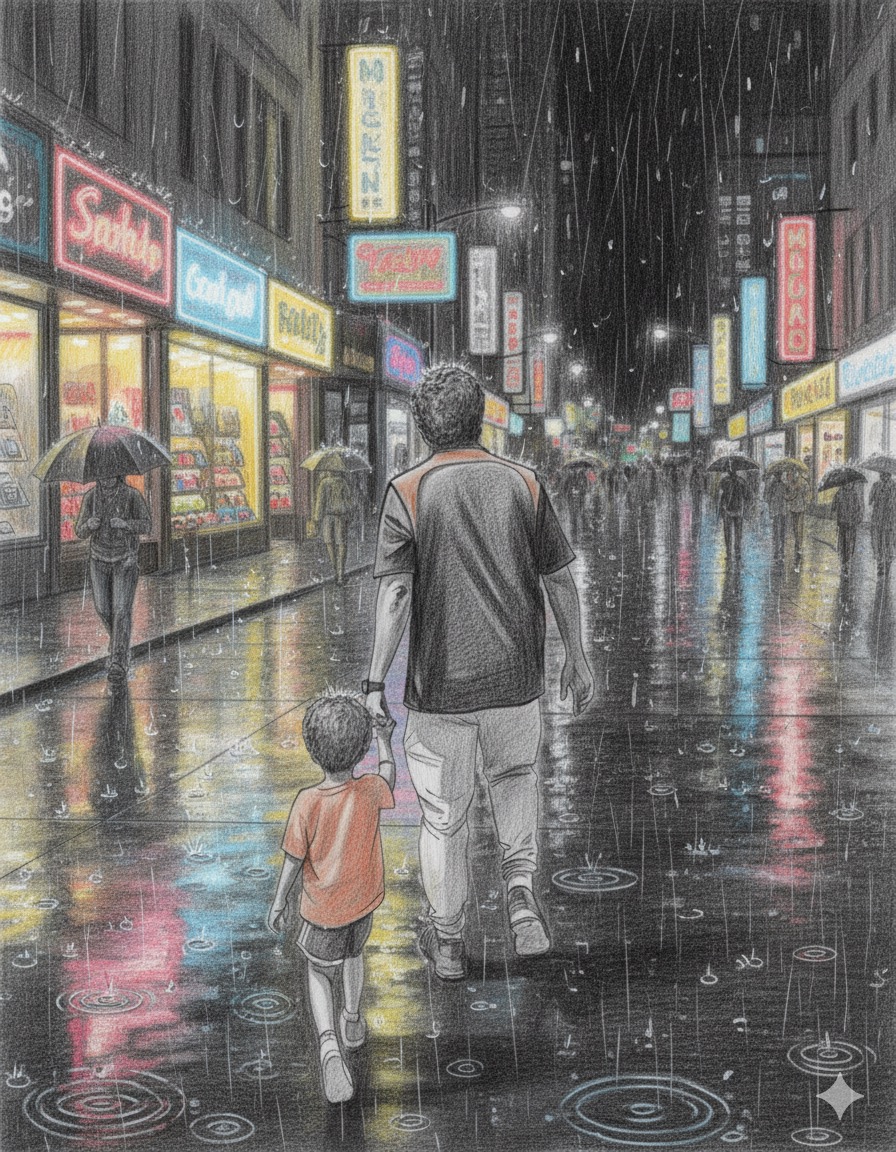
 My daughter is a few months away from four.
Old enough to speak in full sentences, to ask questions that undo me, and to start noticing the invisible lines the world draws around her; lines she can’t name yet, but already senses.
Every day I watch her grow; curious, wild, unfiltered. She runs like she owns the air, laughs with her whole body, argues with the confidence of someone who hasn’t yet learned that society expects her to shrink.
But lately, I’ve been noticing something I can’t unsee.
The world has already started whispering its instructions.
Softly. Sweetly.
Like a lullaby with rules hidden between the notes.
The other day, she was telling her mom about a game she’d seen. She wanted to play it but said, almost as a fact, not a plea:
“I can’t play that game. I’m a girl.”
I froze.
Not in anger, but in a slow, sinking kind of recognition.
I wanted to ask her who told her that, but I already knew.
No one did.
Not directly.
She learned it the way all girls do ; osmosis.
By watching who runs first, who climbs higher, who’s allowed to make noise without apology.
By noticing how adults smile indulgently at boys’ chaos and gently correct hers.
Somewhere between the laughter and the soft “don’t do that,” she found the unspoken rulebook none of us admit exists ; the one that says boys build and girls beautify, boys explore and girls observe.
And that’s when it hit me;
conditioning doesn’t arrive like a storm; it seeps in like humidity.
It starts when they’re barely tall enough to reach the light switch.
A few weeks ago, someone told her, “Put on a bindi, it makes you look so nice.”
She ran to the mirror, eyes wide, mesmerized by her reflection ; as if beauty were a thing newly discovered, not something handed to her.
And there it was again: another lesson taking root.
The idea that looking good isn’t just something to enjoy ; it’s something to maintain.
Lip gloss or bindi, pink shoes or long hair; the props may change, but the script is old.
And the directors? Often the ones who love her most.
Not out of malice, but out of memory.
The kind of memory that has kept women performing womanhood for centuries, polishing themselves into versions of “pleasant” that make the world comfortable.
And I; her dad, who now notices the slightest wetness in her nostril, am realizing how little I once noticed.
Before she was born, I thought I understood gender bias.
I could discuss it intelligently, in that detached, masculine way that turns awareness into a kind of self-congratulation.
But fatherhood destroys detachment.
Because when your daughter looks at you and says she can’t do something because she’s a girl, the conversation stops being theoretical.
It becomes an indictment.
You start seeing how inequality hides; not in boardrooms or policies, but in compliments and corrections.
In tone.
In silence.
You realize patriarchy isn’t an institution “out there.”
It’s a habit “in here.”
Inside homes, inside language, inside you.
So I’m learning; or maybe unlearning;
To watch my reflexes.
To notice when I praise her for being “sweet” but not for being “brave.”
To remind myself that her loudness isn’t defiance; it’s existence.
I know I can’t fix the world for her.
But maybe I can teach her to question it; loudly, relentlessly, without waiting for permission.
Maybe that’s how change begins.
Not with revolution, but with refusal; one father deciding not to pass the quiet inheritance of blindness to his child.
Sometimes, after she falls asleep, I sit in the half-light of her room and replay her day.
Her laughter. Her stubbornness. Her questions that I still don’t know how to answer.
And I wonder;
When she grows up, will she remember the world trying to shape her, or the way I tried to stop it?
Will she carry my hesitations, my small failures to speak in time?
Will she forgive the moments I arrived five minutes too late?
Or will she, one day, simply look at me;
and see the man who finally began to notice?
And is that enough? Perhaps not.
Comments
Post a Comment