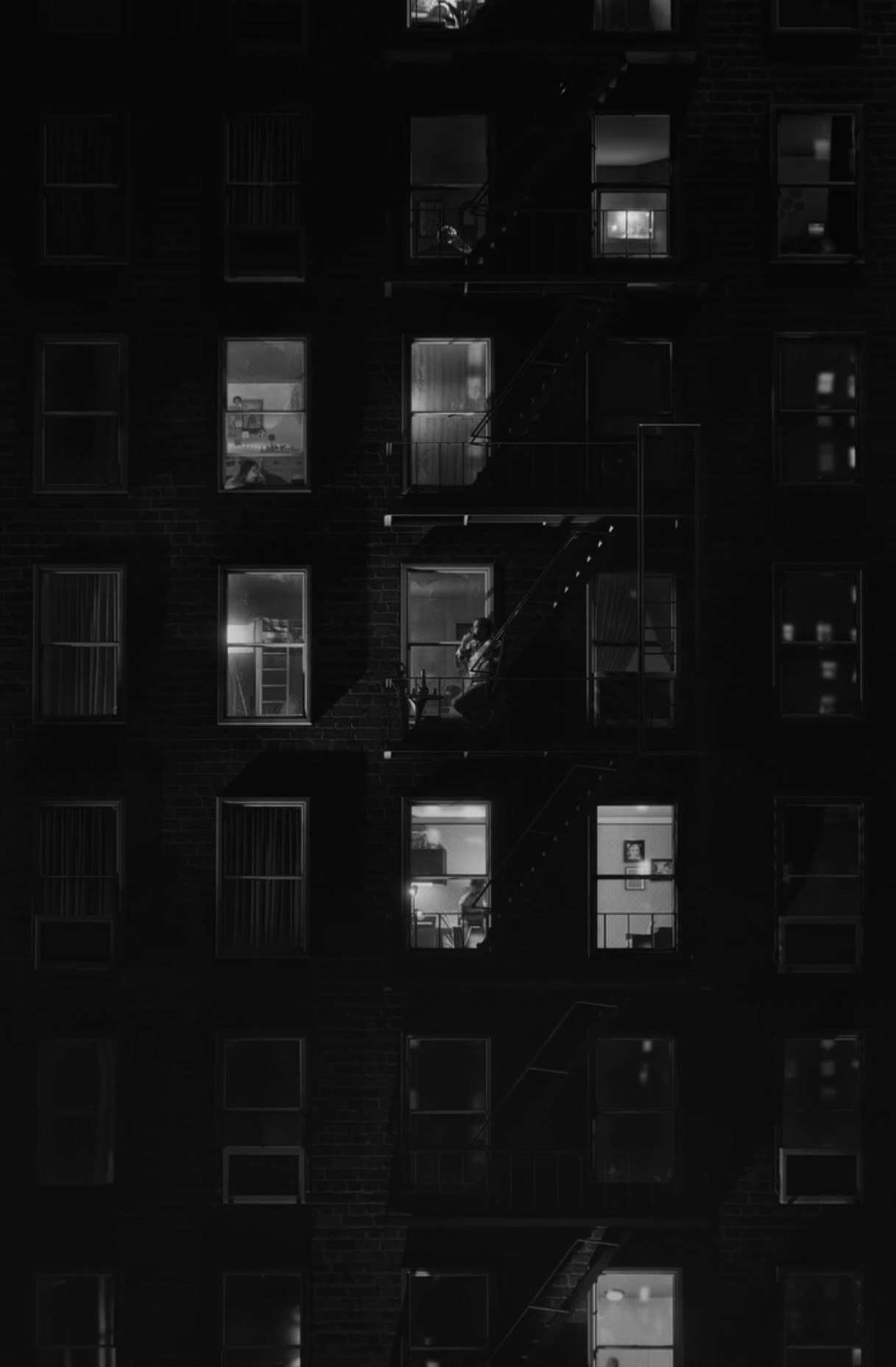
 There is something almost holy about a window at night.
When the world outside falls silent and the darkness presses in, the light spilling from a window becomes more than illumination; it becomes revelation. Each glowing square is a silent confession, a fragment of a story unfolding in parallel to ours. From the street, they all appear equal, amber rectangles adrift in the black. But step closer, and you’ll see that no two lights burn for the same reason.
Behind one pane, two hands are clasped in the soft afterglow of vows exchanged. Their laughter still delicate, still learning how to last. In another, a man sits upright, eyes open to the dark. Insomnia has become his quiet religion, doubt his nightly prayer. A few floors above, someone has lost a job; their shadow bowed before the enormity of an unpromised tomorrow. Across the street, a student bends over a desk, drowning in formulas and fear. And somewhere nearby, a cork pops in triumph; a deal closed, a future secured; while, next door, someone’s world collapses softly against the same wall.
We like to believe the world moves in unison; that we share the same sun, the same moon, the same sequence of days. But these windows break that illusion. They remind us that existence does not unfold in rhythm but in cacophony; joy and grief, creation and collapse, all happening not in order but at once. One person’s ending is another’s first breath. One’s silence, another’s song.
In one home, two voices argue in the half-light, words sharp enough to leave small wounds on the air. In another, two strangers touch for the first time, suspended in the fragile astonishment of being seen. Somewhere, a pen signs divorce papers; elsewhere, another writes “Welcome Home” on a freshly painted wall. Far away, a man counts coins, trying to buy peace one borrowed day at a time.
It is dizzying; this simultaneity of being. The universe does not pause for grief, nor wait for joy to finish before it begins another. The newlyweds laugh as the insomniac stares at the ceiling. The rich man sleeps beneath a chandelier while someone else prays for rent beneath a leaking roof. One floor up, a baby’s cry cuts through the night; one floor down, an old woman exhales her last breath. From the street, their windows look identical. But each flame flickers at its own temperature, each light a small weather system of the soul.
And the glass between us; between me and you; is thin, but absolute. It is the modern condition rendered in architecture: transparent enough to witness, impenetrable enough to separate. We see each other’s outlines, never the whole shape. Their pain makes no sound through the pane. Their joy stops at the glass. So, we mistake the world for balance when it is, in truth, a thousand silent contradictions flickering in parallel.
That is why empathy feels like faith, unseen, unprovable, but necessary. We forget that the one smiling might be holding themselves together with invisible thread. That the one celebrating today might have bled quietly yesterday. We measure our pain against the light of others, never knowing what darkness sustains it. The world is not divided between the fortunate and the broken; it is composed of people who are both, endlessly, at once.
And if you linger long enough before those windows, something shifts. You begin to see not the rooms, but the rhythm. Not the lives themselves, but the pulse that connects them; that stubborn insistence to keep a light burning in the dark. Every room, in its own way, declares; I am still here. Even the insomniac keeps his lamp on, a fragile defiance against the swallowing dark.
From afar, the city becomes a constellation of small resistances.
And somewhere among them, unseen, your own window glows; another star trembling in the great, indifferent night.
And perhaps, when all the lights go out,
the world will still shimmer
with the memory of how we once refused
to be invisible.
And perhaps that is the quiet truth hidden in this architecture of human experience; no one escapes struggle, but no one lives without meaning either. We are all navigating different versions of the same mystery, looking out through our own panes of glass, wondering if someone out there can see us; not just the light, but the person inside it.
So, when you walk past a building at night, and you see those windows; some glowing, some dark; remember that each light is a life in progress. Behind one, someone’s heart is breaking. Behind another, someone’s heart is healing. Some are waiting for morning; others are dreading it. The beauty of it all lies not in their sameness, but in their coexistence.
We are all going through something, just not the same thing. And maybe that’s the most human thing of all.
Comments
Post a Comment